Free delivery on orders of $70 or more (Quebec/Ontario), $100 (rest of Canada) before taxes and after discounts.


Who does regularly suffer from headaches? This health issue affects about 8 out of 10 people and can lead to a reduced quality of life. Sometimes the pain is so intense that it prevents us from carrying out even the simplest day-to-day tasks.
In this article, learn more about headaches—and how to tell them apart from a migraine.
The difference between a headache and migraine
It can be difficult to tell them apart based on pain intensity alone. It’s important to note that migraine discomfort is often very intense and frequently located on one side of the head, as is the case with cluster headache.
Another key difference between migraine and a “regular” headache is the symptoms that come with it. Symptoms that can confirm it’s a migraine may include nausea, vomiting, and visual disturbances such as seeing spots or flashes of light.
Even when a headache is not accompanied by the symptoms mentioned above, the pain can still be just as severe. Also called cephalalgia, two common types of headaches are:
Tension-type headache
This type of headache feels like a tightening or pressure sensation, usually across the forehead and temples. It may also be accompanied by neck pain or stiffness. It can last from 30 minutes to several days.
Vascular headache
The pain is very intense and penetrating, but not throbbing. Tearing, congestion, and sweating may accompany the pain.
Causes of headaches
Identifying the causes of headaches isn’t easy—but it’s often the key to prevention.
It’s important to know there are many possible causes, such as:
- poor posture
- certain foods
- repetitive noise
- stress and anxiety
- lack of sleep
- certain medications
- hormonal fluctuations
- dehydration
- eye strain from prolonged computer screen exposure
To help determine what triggered the headache, w
e recommend keeping a journal and noting the following:
- the quality of your sleep
- where you were
- the date and time of day
- what you ate/drank before symptoms appeared
- your overall condition
- your posture
- whether you consumed alcohol or drugs
- whether you skipped meals
- etc.
Since many causes are pos
sible, no product can guarantee solving the problem 100% of the time. That’s why it’s very important to identify the causes to determine what might trigger a migraine attack.
The pain
Headache-related pain
can be very intense, which is why many medications exist to provide relief.
Unfortunately, many of these medications can cause side effects and may carry significant health risks. To learn more, consult our article on migraines.
It’s also important to know that physical activity has been shown to have a beneficial effect on headaches and migraine management. It’s also relatively rare to experience a headache—or a migraine—during physical exertion.
The mechan
ism behind headache pain
You may be surprised to learn that science still does not fully understand the mechanisms behind this pain. Many studies have been conducted on the subject, yet medical advances still don’t seem to fully resolve it.
Wh
at we
can say is that the pain mechanism is complex and variable. Multiple transmission pathways, signaling agents, and receptors are involved. Some
scientists devote their entire lives to research in this field.
That’s why a product that acts on several different pathways may be recommended to increase the chances of effectiveness—this is often the case with over-the-counter pain relievers.
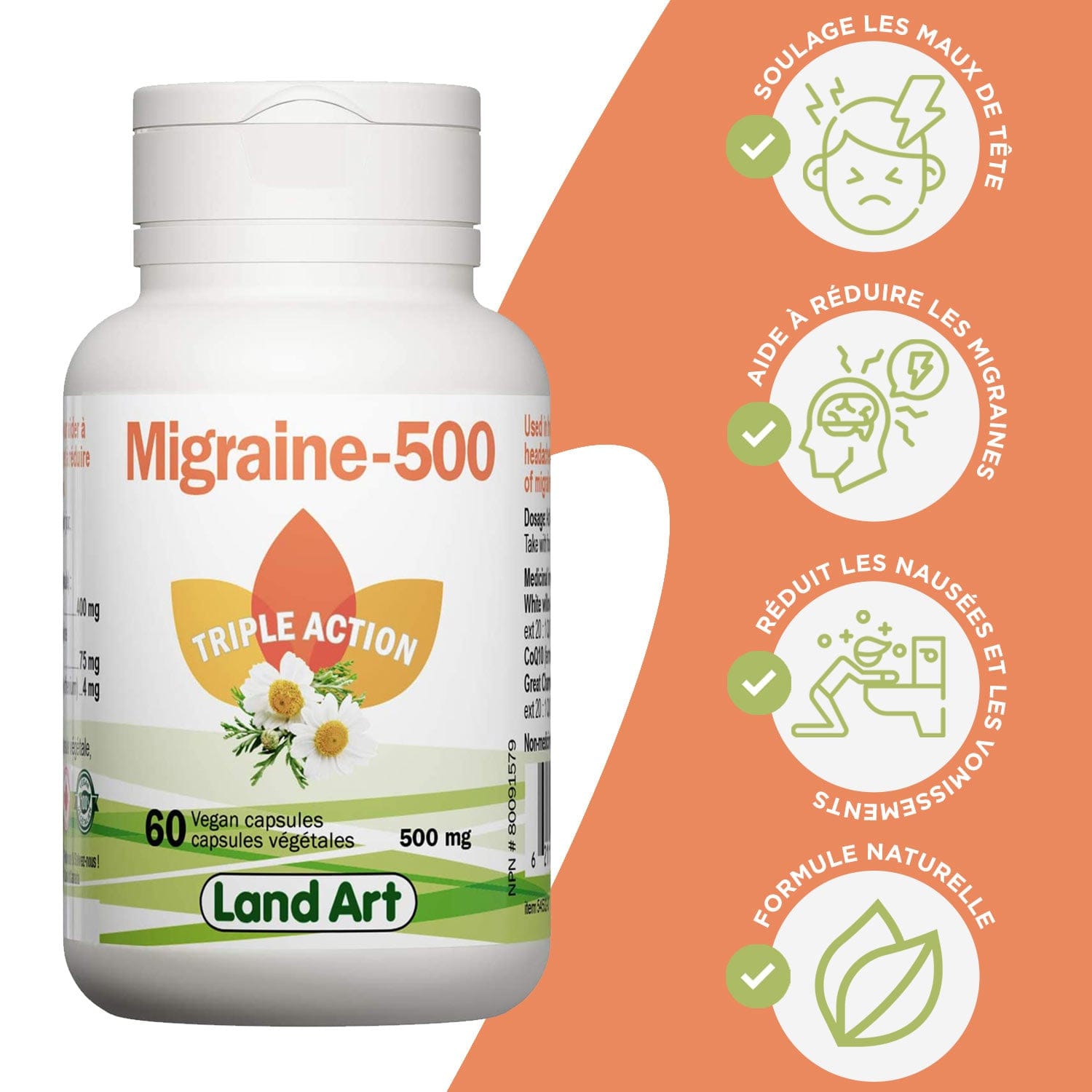
For a more natural alternative, Land Art has specially designed Migraine-500. Fully vegan, it is generally well tolerated and, above all, free of side effects. It is effective for both headaches and migraines. Its three active ingredients work synergistically and are able to cross the blood–brain barrier.
Feel free to contact us if you have any questions. Our mission is your well-being! Please note that if you suffer from headaches, it is wise to consult a physician.
By Nicolas Martineau, B.Sc. in nutrition
References :
Nestoriuc Y, Martin A, et al. Biofeedback treatment for headache disorders: a comprehensive efficacy review. Appl Psychophysiol Biofeedback. 2008;33(3):125-40.
Nestoriuc Y, Martin A. Efficacy of biofeedback for migraine: a meta-analysis. Pain. 2007;128(1-2):111-27.
Nestoriuc Y, Rief W, Martin A. Meta-analysis of biofeedback for tension-type headache: efficacy, specificity, and treatment moderators. J Consult Clin Psychol. 2008;76(3):379-96.
Hermann C, Blanchard EB. Biofeedback in the treatment of headache and other childhood pain. Appl Psychophysiol Biofeedback. 2002;27(2):143-62.
Penzien DB, Rains JC, Andrasik F. Behavioral management of recurrent headache: three decades of experience and empiricism. Appl Psychophysiol Biofeedback. 2002;27(2):163-81.
Rains JC, Penzien DB, et al. Behavioral headache treatment: history, review of the empirical literature, and methodological critique. Headache. 2005;45 Suppl 2:S92-109.
Buture A. et al, Current Understanding on Pain Mechanism in Migraine )and Cluster Headache. 2016 (https://www.ncbi.nlm.nih.gov/pmc/articles/PMC5018152/
Cluster vs. episodic migraine. (2015).
mhni.com/headache-pain-faq/cluster-headaches/cluster-vs-migraine
Headaches: treatment depends on your diagnosis and symptoms. (2015, July 28).
mayoclinic.org/diseases-conditions/chronic-daily-headaches/in-depth/headaches/art-20047375
Migraine. (2013, June 4).
mayoclinic.org/diseases-conditions/migraine-headache/basics/definition/con-20026358
Self-care treatment for headaches. (2012, February 10).
my.clevelandclinic.org/health/diseases_conditions/hic_Overview_of_Headaches_in_Adults/hic_Self-Care_Treatments_for_Headaches
What Is a migraine headache? (n.d.).
hopkinsmedicine.org/neurology_neurosurgery/centers_clinics/headache/conditions/migraine_headache.html
What distinguishes migraine from a sinus-related headache? (2015).
mhni.com/headache-pain-faq/content-disclaimer/sinus-headache