Summer is here, and many people will be spending time outdoors—or simply soaking up the sun without enough protection. The result: sunburn!
This is a broad topic, and in this article we’ll focus on what sunburn is, what it does to the skin, the skin’s repair process, and the products we offer to help.
What is a sunburn?
Sunburn is very different from a thermal burn. Although infrared radiation is what gives the sun its warmth, it’s not heat that burns the skin. A sunburn is actually an acute skin reaction caused by overexposure to the sun’s ultraviolet (UV) rays. It typically appears as skin redness, swelling, and characteristic pain. The skin responds by triggering complex chemical reactions that lead to the symptoms we recognize.
Risk factors
Have you ever wondered why some people get sunburned more often than others? It isn’t only explained by not wearing sunscreen or staying in the sun too long. Several other factors also play a role, such as skin pigmentation, skin type, and taking certain medications—like some antibiotics or even some contraceptives. We’ll share more details on this in a future blog article.
Sunburn damage
Like visible light (colors) and infrared radiation (heat), ultraviolet rays are part of what’s called the electromagnetic spectrum (see the chart below). UV rays are invisible to the naked eye, but they carry much more energy and can be harmful. In fact, UV radiation can damage molecules in the skin—especially DNA.
Excessive sun exposure triggers a chain of reactions that leads to skin inflammation. Generally, this reaction only becomes noticeable 4 to 6 hours later. That’s why sunburn symptoms appear well after sun exposure. The production of prostaglandins and cytokines causes localized dilation of blood vessels in the skin and recruits inflammatory cells. This leads to redness, swelling, and the typical pain associated with sunburn. The warm sensation from sunburn comes from increased blood flow to the area where the skin is damaged.
Another consequence of sunburn: DNA damage can also lead to the destruction of the affected skin cells. This is one of the reasons why the skin peels after a sunburn.
Repair
Once the damage is done, our bodies fortunately have the ability to regenerate. The body triggers a series of reactions to repair DNA damaged by UV exposure and to produce new epithelial cells. This is how a new “layer” of skin forms and the old one peels away.
Although our bodies can repair sunburn damage, it’s important to remember that the more we damage our skin, the more we increase the risk of developing skin cancer.
Nothing replaces prevention: using sunscreen and keeping sun exposure moderate. It’s always better to prevent than to treat!
That said, if you are dealing with a sunburn, we have a product that can help.
Our topical gel with aloe vera
Traditionnellement utilisé pour aider à soulager les brûlures, y compris les coups de soleil, l’aloe vera est reconnu pour ses propriétés hydratantes. L’aloe vera contient également des ingrédients actifs qui aident à réduire l’inflammation et d’autres qui aident à accélérer la réparation de la peau. Ce produit sera votre meilleur ami.
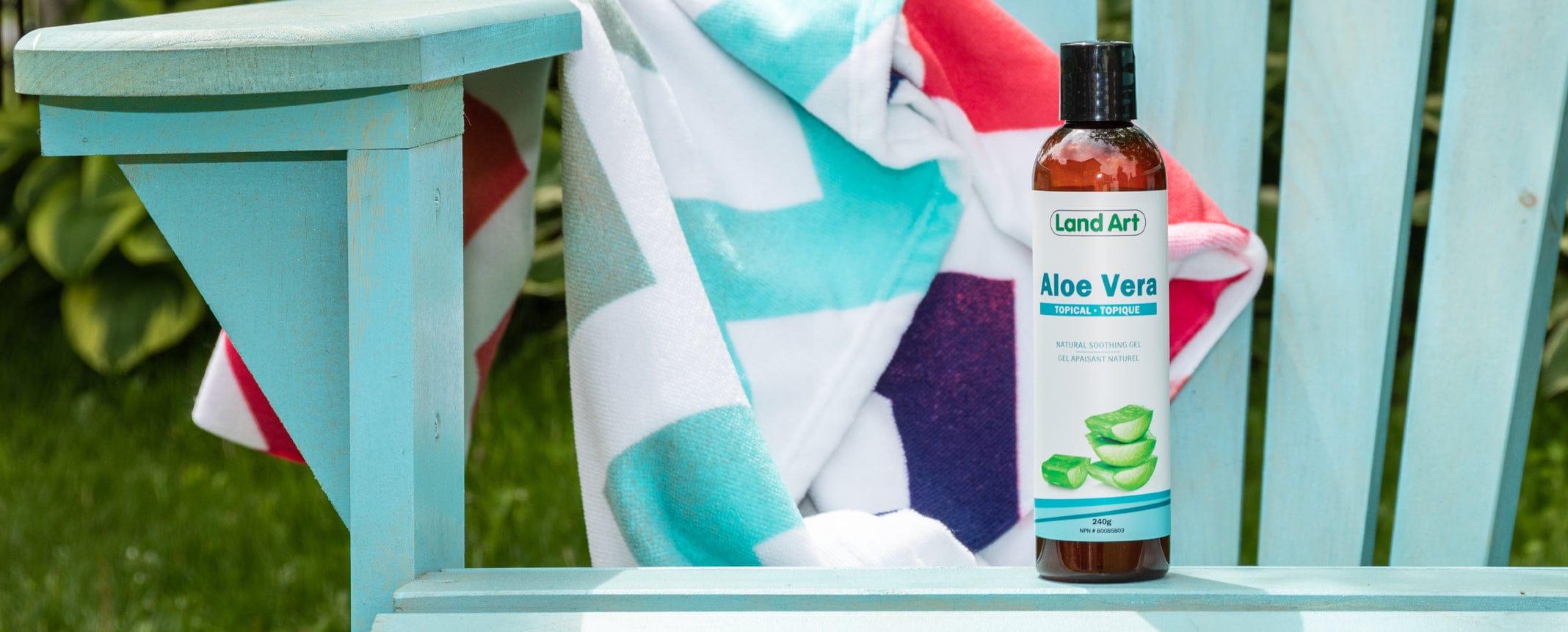
Don’t hesitate to contact us if you have questions about it. Our mission is your wellbeing!
By Michael Deslandes, biologist and Nicolas Martineau, nutritionist
References:
- Sunburns and risk of cutaneous melanoma, does age matter: a comprehensive meta-analysis ; Leslie K. Dennis, M.S., Ph.D.,1 Marta J. VanBeek, M.D., M.P.H.,2 Laura E. Beane Freeman, Ph.D.,1 Brian J. Smith, Ph.D.,3 Deborah V. Dawson, Ph.D.,3,4 and Julie A. Coughlin, M.P.H.1
- CXCL5 Mediates UVB Irradiation–Induced Pain; John M. Dawes,1 Margarita Calvo,1,* James R. Perkins,2,* Kathryn J. Paterson,1,* Hannes Kiesewetter,1 Carl Hobbs,1 Timothy K. Y. Kaan,1 Christine Orengo,2 David L. H. Bennett,1,3 and Stephen B. McMahon1,†
- “Sunburn – Topic Overview”. Healthwise. 15 November 2013. Retrieved 29 November 2014.
- Protective effect against sunburn of combined systemic ascorbic acid (vitamin C) and d-α-tocopherol (vitamin E); Bernadette Eberlein-König, MDMarianne Placzek, MD Bernhard Przybilla, MD
- Sunburn; Karla C. Guerra, Jonathan S. Crane, NCBI Bookshelf, January 2020. https://www.ncbi.nlm.nih.gov/books/NBK534837/
- https://fr.qwe.wiki/wiki/Sunburn