Capsules - Unflavoured
2974$
3499$
Free delivery on orders of $70 or more (Quebec/Ontario), $100 (rest of Canada) before taxes and after discounts.
Menopause is a natural stage in a woman’s life. Yet, it is far from being experienced the same way by every woman.
Some go through this period with relatively little discomfort, while others must contend with several symptoms at once: hot flashes, night sweats, disturbed sleep, fatigue, mood swings, difficulty concentrating, and much more.
And that is precisely what makes menopause so unique: no two women are alike, and no two menopause experiences are the same.
According to the World Health Organization (WHO), natural menopause generally occurs between the ages of 45 and 55. A major Canadian survey of women aged 40 to 60 revealed that 95% of them had experienced symptoms associated with menopause—an average of 7 different symptoms per person.
Even more surprisingly, nearly one in two women reported feeling ill-prepared for this stage of life.
When we think of menopause, hot flashes are often the first thing that comes to mind. However, the changes involved can be much more extensive.
Sleep may become more difficult, energy levels may drop, and moods may shift. Some women also describe “brain fog”—feeling less able to concentrate, struggling to find the right words, or noticing that they are more forgetful than before.
Additionally, there may be changes related to sexuality and genitourinary health.
All of these manifestations can have a significant impact on quality of life, relationships with loved ones, and even professional life.
In one Canadian survey, 41% of the women polled indicated that their symptoms had a negative effect on their relationship with their partner.
The consequences are also felt in the workplace. An analysis conducted in collaboration with Deloitte Canada estimates that unmanaged menopause symptoms cost the Canadian economy approximately $3.5 billion annually, primarily due to lost productivity and missed workdays.
Menopause is linked to the natural aging of the ovaries. During the years leading up to menopause, the production of hormones such as estrogen and progesterone becomes increasingly irregular. As a result, menstrual patterns may change, and various symptoms may emerge.
Contrary to popular belief, hormone levels do not necessarily decline in a gradual, steady manner. Instead, they can fluctuate significantly during this period, which helps explain why symptoms may vary from one week or month to the next.
This transitional phase is known as perimenopause.
A woman is officially considered to have reached menopause when she has gone 12 consecutive months without a menstrual period, assuming there is no other underlying cause. The period that follows is called postmenopause.
Unfortunately, there is no single answer to this question.
For some women, the symptoms are relatively short-lived, while for others, they may persist for several years.
A major American study found that for women who regularly experience hot flashes and night sweats, these symptoms last for a median duration of approximately 7.4 years.
Furthermore, when these symptoms begin early in the transition toward menopause, their median duration can sometimes exceed 11 years.
Menopause, therefore, is not necessarily a brief phase to endure; for many women, it is a transition that spans several years.
Despite the number of women affected, menopause remains a topic that is still not discussed enough today.
The Menopause Foundation of Canada reports that fewer than a quarter of the women surveyed said their family doctor had brought up the subject of menopause with them.
Even among healthcare professionals, specialized training remains somewhat limited. A study of North American pharmacists with specialized certification in menopause reported that 52% of them had received no specific training on menopause during their pharmacy studies or postgraduate education.
It is therefore not surprising that some women sometimes find it difficult to understand what they are experiencing or to learn about the various options available to them.
Since every woman experiences menopause differently, there is no single solution that works for everyone.
Lifestyle habits are, of course, a good starting point. Physical activity, a balanced diet, stress management, and healthy sleep habits can all contribute to overall well-being during this period.
Depending on the symptoms and their severity, other options may also be considered, including certain non-hormonal treatments, hormone therapy, and natural health products.
Menopausal hormone therapy, in particular, is recognized as one of the most effective treatments for reducing hot flashes and night sweats. Various options are now available, and the choice of treatment should be evaluated with a healthcare professional based on each woman’s specific symptoms, needs, and medical history.
Many natural health products approved in Canada are designed for women going through menopause.
These often contain ingredients such as soy isoflavones, black cohosh, red clover, dong quai, and sage, as well as various vitamins and herbs traditionally used to promote sleep or support mood.
Soy isoflavones and black cohosh are among the most extensively studied ingredients. Some research indicates positive effects on various menopause-related symptoms, though results can vary depending on the specific extracts used, the dosages, and the individuals studied.
This highlights an important point: menopause is not defined by a single symptom.
One woman might experience hot flashes while still sleeping perfectly well. Another might primarily struggle with fatigue, mood swings, or difficulty concentrating. A third might experience several of these symptoms simultaneously.
Given this, it is unlikely that any single ingredient could address every need.
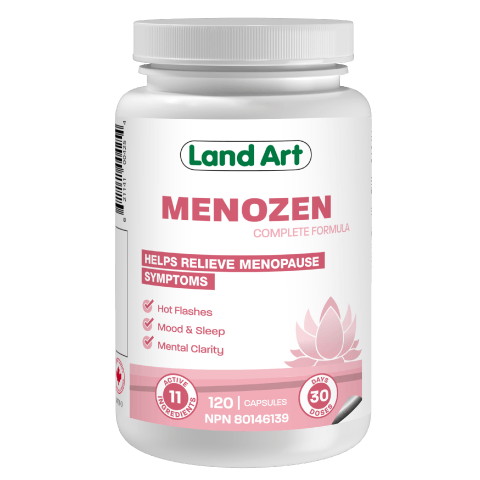
It is precisely this reality that guided us in the development of MenoZen by Land Art.
Rather than simply selecting one or two popular ingredients associated with menopause, we conducted extensive research and analyzed available scientific studies to develop a unique and far more comprehensive formula.
We also placed special emphasis on the quality of the medicinal ingredients used. MenoZen contains several concentrated, standardized extracts, resulting in a formula that is as complete and precise as it is consistent. What particularly distinguishes MenoZen is its unique combination of DIM with several other carefully selected medicinal ingredients designed to address the various manifestations of menopause. MenoZen is the only product that brings DIM together with this specific blend of ingredients.
The formula contains 11 medicinal ingredients: vitamin C, citrus bioflavonoids rich in hesperidin, sage, DIM, soy isoflavones, black cohosh, chasteberry (vitex), dong quai, St. John’s wort, American ginseng, and piperine. Many of these ingredients are included as concentrated or standardized extracts—notably the soy isoflavones, black cohosh, and St. John’s wort.
The rationale behind this formula is simple: menopause is not defined by a single symptom. It therefore seemed logical to us to adopt a more holistic approach rather than relying on just one ingredient.
DIM, or 3,3’-diindolylmethane, is a compound derived from substances naturally found in cruciferous vegetables such as broccoli, cauliflower, and cabbage.
DIM is particularly noteworthy for its role in estrogen metabolism. It acts primarily in the liver, where it promotes specific pathways that allow the body to metabolize estrogens more effectively. This mechanism is especially relevant during menopause—a period when hormonal balance undergoes profound changes.
While scientific data regarding its direct effect on menopausal symptoms is still in the early stages, it is highly promising. For this reason, we do not view DIM as a standalone solution, but rather as a complementary component within a much more comprehensive formula. This is, in fact, what makes MenoZen unique: it combines DIM with several medicinal ingredients, carefully selected to offer a more comprehensive approach to menopause. As a result, MenoZen is better equipped to effectively address the various symptoms that may arise. It is precisely this product that helped my partner eliminate 90% of her symptoms. She has been using it for over two years now, and it has provided her with complete relief.
Because no two women are alike, no two menopause experiences are the same.
Gaining a better understanding of this transition—and the various options available—empowers every woman to find the approach that best suits her individual needs.
By Nicolas Martineau, B.Sc. in Nutrition
Main references
Capsules - Unflavoured

Concentrated extract

Lemon and Lime

Cherry